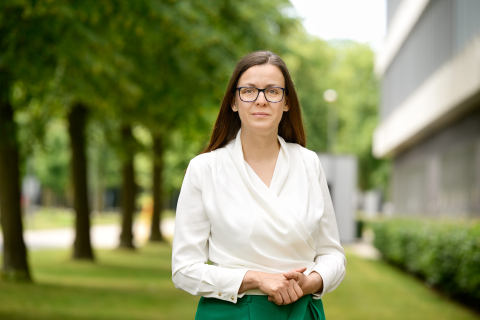
DIFFER researcher and group leader Beata Tyburska-Pueschel has been appointed as a parttime associate professor Material Science and Engineering at TU Delft. As of this summer, she will combine her work at DIFFER in Eindhoven with the professorship at the university in Delft.
In a recent interview with Beata Tyburska-Pueschel in 2025, the group leader of the Radiation-Induced Defect Research group (RIDER) already announced that she had ambitious plans for the future. “Now is the moment it is going to take off”, the senior researcher passionately said. That these words were backed up by action, appears from the fact that she has been appointed as associate professor at the Mechanical Engineering department of TU Delft.
Driving force
Since she started at DIFFER in September 2019, Tyburska-Pueschel has been the driving force behind significant developments at the institute. Starting with an Ion Beam Facility (IBF) that operated 500 hours per year for fewer than five users in 2019, to a facility that operates 3500 hours for about 20 users in 2025. It’s a facility that can be used for ion beam analysis and ion irradiation, which paves the way for in-depth studies of energy materials. With the upcoming professorship at TU Delft, the time has come for Tyburska-Pueschel to hand over the responsibilities as scientific facility owner at DIFFER to a new expert.
At TU Delft, besides lecturing students, Tyburska-Pueschel’s position involves the development of one among three new nuclear mastertracks, which are scheduled to open in September 2028. For the teaching part, the ambitious associate professor has a clear vision in mind: “When I teach my students, I want to look broad. We don’t know yet for what type of reactor concept The Netherlands will choose in the future. Hence, I want my students to know all the concepts and most of all, how the requirements will change when the size of a reactor does. What does that mean in terms of properties? What are the constraints? For this reason, there will also be a close collaboration with the Dutch nuclear industry. In the end, the students we teach will be the specialists they need.”
In addition to her professorship at TU Delft, Tyburska-Pueschel will carry on her work as RIDER’s group leader at DIFFER. This group is dedicated to advancing our understanding of the synergistic effects of radiation and corrosion in materials, with a particular focus on those used in molten salt reactors (MSRs) and in fusion blankets. In this group leader role, Tyburska-Pueschel will continue supervising ongoing projects, collaborations, students, and scientific activities associated with the group.
Positive developments
For Tyburska-Pueschel, the professorship is a positive development in several respects. Apart from the possibility of promoting her own students, there will be ample of network opportunities between the university, research institutes and industry. However Tyburska-Pueschel has quite some experience in mentoring students, teaching is a field in which she can improve her skills.
“In the future, I strongly prefer to take my PhD students from my own master courses. Promoting my own students is one thing I’m really looking forward to. They will be educated in the area where they are very much needed. While teaching them, I get the chance to get to know the students and their skills better. Imagine that your master students come back to you as your PhD student, after all the networking efforts and research. That’s something I’m already excited about”, shows Tyburska-Pueschel her enthusiasm and future ambitions.
Author: Rianne van Hoek
Go to the News page.