The Catalytic and Electrochemical Processes for Energy Applications (CEPEA) group has reached an inspiring milestone: 50 peer-reviewed publications with DIFFER affiliation, achieved in nine years since establishing its own laboratory facilities.
Dr. Mihalis Tsampas joined DIFFER in 2014, but it was not until the end of 2016 (after securing dedicated research space) that the group could begin generating its own experimental results and original ideas. Since then, CEPEA has grown into a vibrant research ecosystem spanning the full landscape of electrochemical conversion. From water splitting and CO₂ valorisation to nitrogen fixation, and extending beyond classical electrochemistry into light-assisted and plasma-assisted activation routes.
It is worth noting that this 50th publication also marks the first scientific output of the HyPRO consortium, as the publication has been achieved within the framework of the HyPRO project, supported by the National Growth Fund. The article addresses strategies to overcome degradation effects at the device level, contributing essential insights toward the development of durable and high-performance water electrolysis technologies.
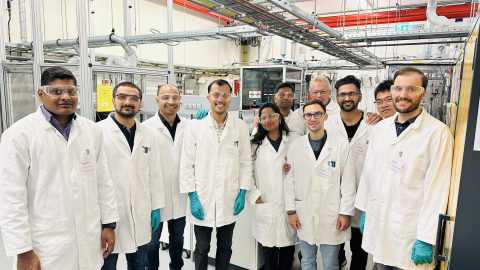
Exceptional collaborations
“This milestone reflects the collective effort of exceptional people”, dr. Tsampas said. “Our research now covers almost the entire spectrum of electrochemical conversion technologies, and this diversity is only possible thanks to the talent and dedication of my group members.”
Tsampas expresses his deep appreciation to several long-standing collaborators and supporters. In particular, he would like to thank his colleagues at DIFFER: Richard van de Sanden (for introducing him to the ‘plasma virus’ and fostering interdisciplinary exploration), Stefan Welzel (for his continuous support in experimental infrastructure and plasma system development), and Hans van Eck (for enabling access to fusion-related nanostructuring facilities). He also warmly acknowledges Adriana Creatore (TU/e) for the productive collaboration in atomic layer deposition (ALD). Last but not least, he extends his gratitude to Hannah Johnson (Toyota Motor Europe) for supporting the group’s initial activities in photoelectrochemistry and giving a strong boost to this research line.
Past and future efforts
The past years, CEPEA group’s activities have been executed through 33 research programs, supported by Dutch and EU funding agencies as well as industrial partners. Key highlights of the group’s work include the development and scaling of photoelectrochemical hydrogen production, the integration of plasma in electrochemical systems for nitrogen fixation toward green fertilizers, and advanced material development for efficient carbon dioxide valorisation into syngas and/or methane. Beyond scientific publications, the group’s research has also generated seven patents, demonstrating the strong technological impact and valorisation.
The CEPEA group now looks ahead to new challenges, expanding capabilities, deepening collaborations, and continuing to push the boundaries of electrochemical energy research at DIFFER. Tsampas: “Above all, I want to thank my group members. Without their hard work, creativity, and perseverance, this achievement simply would not have been possible.”
Visit DIFFER’s repository to view research output, like journal articles, conference proceedings and papers, PhD theses and other materials published since 1985.
Authors: Mihalis Tsampas, Rianne van Hoek
Go to the News page.