Two postdoctoral researchers of DIFFER have been awarded a EUROfusion grant. With the Engineering Grant (EEG), Maria Morbey will work on some of the key technological questions that arise when realising fusion energy. The Research Grant (ERG) enables Stefan Dasbach to develop innovative ideas aligned with EUROfusion’s Roadmap to Fusion Energy.
The EUROfusion consortium, Europe’s coordinated fusion research programme, has selected nine Bernard Bigot Researcher Grant (ERG) and fourteen Engineering Grant (EEG) recipients from leading institutions across Europe. These prestigious grants recognise scientific excellence, innovation, and diversity, empowering Europe’s next generation of fusion experts to help realise fusion energy.
Tungsten
With a EUROfusion Engineering Grant, Maria Morbey will work on a research project called ‘Influence of synergistic proton and plasma loading on retention in tungsten’. Morbey aims to determine the temperature shift between neutron and proton irradiation required to produce similar defect structures in tungsten and to identify the synergies between simultaneous plasma exposure and damage, allowing for better estimates of the defect density in tungsten plasma facing components and tritium retention.
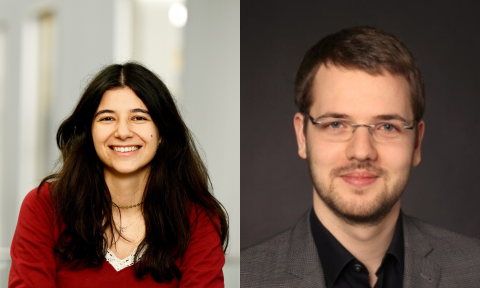
Morbey: “As we move closer to realising fusion power plants, understanding neutron-induced damage becomes increasingly important. At DIFFER, we have Upgraded Pilot-PSI (UPP), a unique facility that combines proton irradiation with reactor-relevant plasma exposures. In fission research, protons have long been used as an effective proxy for neutrons, allowing scientists to reach target dpa levels much faster and without long cooling periods before samples can be safely handled. This makes us believe that protons are also a good proxy for neutron damage in fusion materials and conditions.
I’m excited to return to UPP, but this time using the ion beam as a damage tool rather than as a diagnostic one, as I did during my PhD. While I’m still very much in the plasma-material interaction realm, this project gives me the chance to explore radiation-damage effects in materials (a new direction for me) as well as shifting from liquid metals to solid metals. And even with this shift I get to work with my favourite tool: the ion beam.”
Intersection
The research of Stefan Dasbach will have a wide-reaching impact. With his topic ‘Physics-constrained deep learning models for power plant scale exhaust’ he will he will work at the intersection of plasma exhaust modeling, AI, and control at the same time. The main objective of his project is to advance deep learning models that preserve main physical constraints while adapting to experimental data, thereby narrowing the simulation-reality gap. Achieving this demands a multi-faceted strategy, combining physics-informed learning with robust model generalization.
Dasbach: “Simulations of the heat exhaust in tokamaks are very challenging and up to now struggle to reproduce experimental measurements. I think the recent improvements in simulation and machine learning techniques enable novel possibilities to overcome this barrier. I am glad this grant allows me to work towards this goal and to learn from the people operating the various tokamaks around the world.”
EUROfusion
The research projects of both researchers start on 1 January 2026. Both grants have a maximum duration of two years. More information about these EUROfusion grants and other awarded projects can be found on the website of EUROfusion.
Author: Rianne van Hoek
Go to the News page.