A consortium DIFFER is part of, will receive 6,119,050 euros in funding from the National Nuclear Energy Research Programme. Co-funders are contributing approximately 400,000 euros to the project budget. The aim of the awarded RENESSANCE project is to encourage further research into new technologies in the field of nuclear energy, particularly in the areas of small modular reactors (SMRs) and advanced modular reactors (AMRs).
The call for proposals ‘Technology for innovative nuclear reactors and fuels’ sought research that could support the development of a new generation of reactors. In the long term (after 2040), these could play a significant role in the energy transition due to their use of passive safety systems and advanced coolants for greater efficiency.
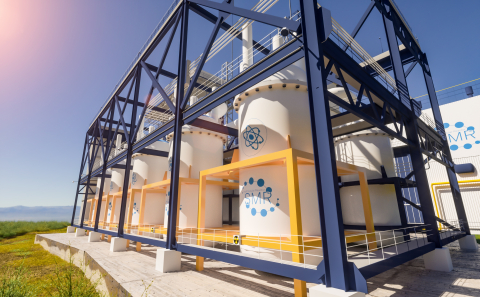
Through intensive casco workshops, various stakeholders interested in this topic came together to formulate a single joint research proposal. The consortium thus comprises a group of researchers from various universities (of applied sciences), and companies.
About the awarded RENESSANCE project
RENESSANCE stands for ‘Research and Education for Nuclear Energy to Support Safety Assessment and Nuclear Community Engagement’. The project brings together Dutch universities and research institutes active in the nuclear sector to facilitate the design and construction of innovative Generation IV nuclear reactors. This concerns, in particular, the high-temperature gas-cooled reactor (HTR), the molten salt reactor (MSR) and the lead-cooled fast reactor (LMR). To this end, the consortium has defined various priority areas to accelerate the development of these reactors and the necessary licensing process.
The project focuses in particular on theory and numerical models to better predict and validate the behaviour of new fissile fuels and nuclear materials under the challenging conditions of Generation IV reactors, so that long-term irradiation experiments can be carried out more efficiently and quickly.
It also focuses on accurate numerical simulation models to validate existing code packages for Generation IV reactors, and new detectors, detection mechanisms and signal processing methods based on machine learning will be developed to further enhance the safety and flexibility of these Generation IV reactors, ensuring they integrate well into the future electricity grid.
Finally, a database of all stakeholders in the Netherlands will be developed to establish a European industry capable of designing, building and operating these new reactors.
Embrittlement
"My research under RENESSANCE focuses on how helium produced during neutron irradiation affects the embrittlement of nickel-based alloys", explains DIFFER’s group leader Beata Tyburska-Pueschel. "In collaboration with NRG PALLAS, we will investigate neutron-irradiated materials to understand the mechanisms responsible for embrittlement. At DIFFER, we will use our DICE facility to extend these studies to a wider range of alloys, irradiation doses, and temperatures using proton and helium irradiation. This will also allow us to investigate how well ion irradiation can reproduce neutron-induced degradation. Ultimately, we aim to understand why these materials become brittle and provide the knowledge needed to predict their lifetime and support safe reactor operation."
The project will provide a great learning opportunity for students as well. "The collaboration offers students a unique opportunity to gain hands-on experience working with radioactive materials at specialised nuclear research facilities", Tyburska-Pueschel points out.
Key players
The RENESSANCE project matches well with DIFFER's ambitions. "The mission of DIFFER is to perform leading fundamental research on materials, processes, and systems for a global sustainable energy infrastructure", says DIFFER's director Marco de Baar. "While the materials aspects in modern nuclear fission are evident, this program also focuses on the systems aspects, such as the instrumentation and control aspects of modern fission reactors. It brings together a number of key players in the nuclear domain. This network is trailblazing our ambitions for the development of a nuclear ecosystem in the Netherlands.”
In such a wide, multidisciplinary framework, several opportunities for industrial applications may appear, as De Baar points out. "Developing the research ecosystem and tracking how innovations from this program are connected to the industrial activity is one of the activities that I will focus on myself.”
Dutch nuclear energy research programme
RENESSANCE is the first funded project within the multi-year research programme ‘Dutch nuclear energy research programme’. The programme aims to strengthen the nuclear knowledge base in the Netherlands and make it future-proof. The Dutch government has decided to give nuclear energy a greater role in the future Dutch energy system. The Dutch nuclear energy research programme was developed to contribute to this. Funding for this multi-year research programme comes from the Ministry of Economic Affairs and Climate Policy and the Ministry of Infrastructure and Water Management.
Visit the website of NWO for an overview of all applicants, co-funders and collaboration partners.
Go to the News page.