The SHIELD-PEM project has been awarded funding through the NWO Knowledge and Innovation Covenant (KIC) programme. In this project, researchers and companies work together to advance sustainable hydrogen technologies.
By combining academic and industrial expertise, SHIELD-PEM will contribute to more affordable, sustainable and less vulnerable green hydrogen production. SHIELD-PEM stands for ‘Sustainable Hydrogen Production by Integrated, Low CRM Engineering & Design for PEM Water Electrolysis’.
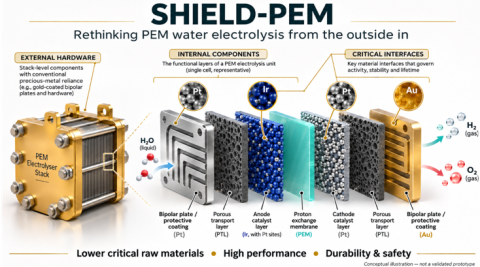
Coordinated by DIFFER, with Dr. Michail Tsampas (DIFFER) as Principal Investigator and Prof. Mariadriana Creatore (TU/e) as co-Principal Investigator, the project brings together a strong consortium of academic and industrial partners: DIFFER, TU/e, ElementH2, SparkNano, Toyota Motor Europe, DENSsolutions, and VSParticle.
System-level approach
SHIELD-PEM takes a system-level approach to reducing critical raw material consumption, extending beyond conventional strategies focused primarily on catalysts. The project addresses CRM use throughout the PEM electrolyser architecture, from external hardware and protective coatings to internal components and critical interfaces.
Through the development of advanced materials, innovative catalyst deposition techniques, alternative protective coatings, and optimized cell components, SHIELD-PEM aims to reduce dependence on precious metals while maintaining high performance, efficiency, durability, and safety.
By combining expertise in electrochemistry, materials science, nanotechnology, advanced characterization, and industrial manufacturing, the consortium aims to develop practical solutions that reduce precious metal dependence without compromising electrolyser performance or safety.
Ultimately, SHIELD-PEM will contribute to more affordable, sustainable, and scalable green hydrogen production, supporting Europe's energy transition and technological independence.
About the KIC call
Under the KIC call ‘Reducing reliance on critical raw materials in the energy transition’, a total of four million euros has been allocated to four projects. The projects will take various approaches to reducing reliance on scarce and geopolitically risky raw materials in the energy transition.
The four projects focus on different areas of application: they will design wind turbines, PEM electrolysers and new forms of battery storage that significantly reduce the use of critical raw materials. This will make us less dependent on materials such as iridium, platinum, gold and titanium.
More information can be found on NWO’s programme webpage.
Go to the News page.