What does a career in fusion research actually look like? For PhD candidates David Becker, Max Winkel and Rick van Schaik, it started with curiosity during their studies at Eindhoven University of Technology (TU/e). Along the way, they explored opportunities abroad, collaborated with international research institutes and industry partners, and ultimately found their place at DIFFER.
The three researchers followed different paths into fusion, but they all cross at the Fusion Master at TU/e. What their stories have in common is a genuine, dedicated passion for discovery, and excitement for one of the greatest scientific and technological challenges of our time.
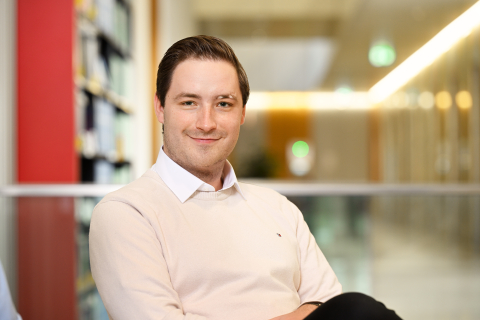
David Becker had his first contact with fusion during his final Bachelor's project at DIFFER, focused on plasma physics. He went on to pursue the double master's program in Applied Physics and Fusion at TU/e, during which he did an internship at ITER, the world's largest fusion experiment, working on charge-exchange diagnostics. Today, he is a PhD candidate at DIFFER, researching electron cyclotron resonance heating, a technology used to heat up and control fusion plasmas.
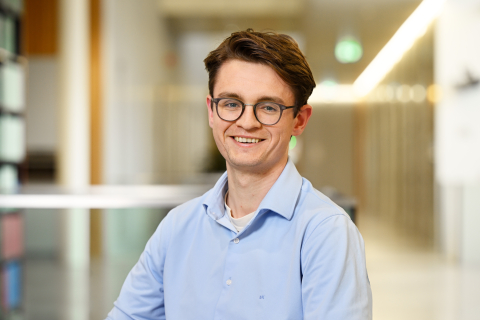
Also Max Winkel studied physics at TU/e and followed the double master's program in Fusion and Applied Physics. Alongside his studies, he spent a gap year contributing to SOLID, a student innovation team based in Eindhoven focused on developing a sustainable energy storage system using iron as a circular energy carrier. Here, he learned a practical approach to science, collaborating with other fellow students to develop industry-oriented technologic innovation. Later, an internship at the Max Planck Institute for Plasma Physics in Germany exposed him to the international network of fusion research. For his graduation project, he joined the Energy Systems and Control group at DIFFER, where he’s now working as a PhD student.
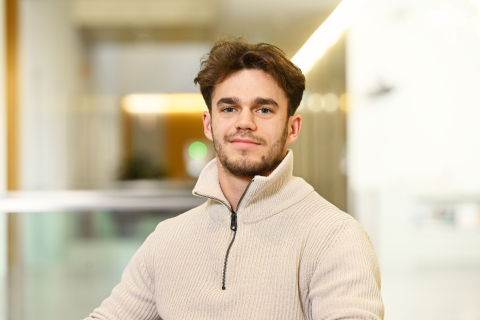
For Rick van Schaik, fusion feels more like a vocation rather than a professional choice. "I always knew my place was in fusion", he tells, with genuine enthusiasm in his eyes. During his bachelor's in Applied Physics at TU/e, he completed his final research project at DIFFER's Plasma Material interaction group and later followed the Fusion master's program at TU/e. His studies took him to the Barcelona Supercomputing Center, where he worked on modelling plasma heating, and later to Ignition Computing, a software startup based in Eindhoven working for ITER, among others. After connecting with researchers at DIFFER, he got a PhD position in the Integrated Modelling research group, where he is working on novel methods to simulate the fusion reactor plasma as a whole, while keeping the computational time manageable.
Looking beyond Eindhoven
All three researchers agree on the importance of networking in fusion. "Soon you will discover that the fusion community is not so big", Winkel explains. "By visiting conferences, as well as travelling to other institutes, you rapidly collect ties across all the main research areas. This is essential to keep trace of the progress going on outside your own research." Knowledge exchange is necessary in such a challenging field as fusion, where researchers are faced with so many different problems. Which materials can withstand the extreme temperatures of the plasma? How can we control the process? How can we improve efficiency to make fusion an economically viable option for future energy?
Working abroad shows you new perspectives, different ways of conducting research and a broader professional network that can help answer these questions. This brings us to why the three researchers chose DIFFER after their studies.
Why DIFFER?
"I really like the opportunities to go abroad”, says Van Schaik with confidence. "It's impressive how much I travelled this year. From a student's or young researcher's point of view, it really makes the difference for your career.” Throughout the years, DIFFER has established strong research partnerships around the world, including Europe, Japan, the United Kingdom and the United States. For young scientists, this is an extraordinary occasion to build a global network from the beginning of their careers.
Besides the international networking, students and researchers at DIFFER are often offered the opportunity to take the lead of their own project. "This gives you the freedom of experimenting. You are given a goal and how you reach it, that's up to you. This is absolutely unique", says Winkel with enthusiasm. "You can manage your project yourself", says Van Schaik. "You have a lot of control and a lot of responsibility."
For Becker, another strength is the institute's multidisciplinary environment. "You can easily gain practical experience in any research area you want.” Fusion requires expertise in plasma physics, materials science, diagnostics, control systems, modelling and engineering. At DIFFER, you’ll find all these fields. "You can learn so much from just a chat during a coffee break", adds Winkel.
The researchers also highlight the strong ties between DIFFER and TU/e. "Many researchers teach, supervise students or collaborate directly with university groups", Winkel points out. This creates a natural link from education into research.
For students, opportunities are available at every stage, from bachelor's projects and internships to master's theses and PhD positions. "At DIFFER, bachelor's and master’s students can easily find opportunities for their final project", says Becker.
Contributing to a bigger mission
The enthusiasm of the three researchers is almost tangible in the room, as they speak about their research. For Becker, motivation lies in the combination of advanced physics and societal impact. "You are working on something that has real value for society", he says. "It is advanced physics, which is already exciting itself, but the concrete outcome really motivates me.”
Van Schaik shares a similar perspective. He describes fusion as one of humanity's most ambitious long-term goals. "We're trying to harness the energy of the stars", he says. "We are facing one of humanity's biggest challenges. To contribute to a solution that could have such an impact on mankind as a whole is incredibly inspiring to me."
Author: Allegra Polato
Go to the News page.