It’s already been two years since NWO announced the launch of the HyPRO consortium, arising from the GroenvermogenNL programme, to research carbon-neutral hydrogen production. The received grant enables the consortium to develop and improve electrolysis technology, and to develop a Dutch supply chain for materials, components and systems. In the meantime, several students and lecturers embarked on the project at DIFFER. What about their experience?
‘The consortium HyPRO: Towards flexible, durable, and high-performance Hydrogen Production Technology’: it’s one of the sentences that can be read in the public announcement of NWO in September 2024. Now that the project is entering its third year, we take a look at the various students and lecturers who are involved in the project.
Joint effort
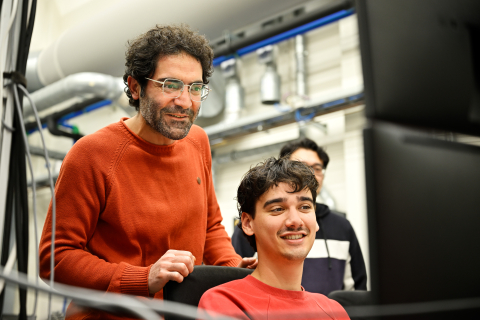
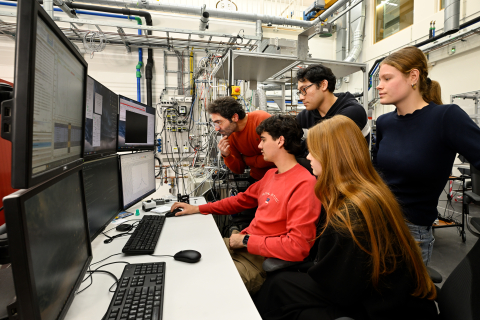
“I really want to highlight the importance and added value of the collaboration between research institutes like DIFFER with Universities of Applied Sciences like Fontys Hogeschool”, tells Babak Sadeghi, postdoctoral researcher in DIFFER’s Plasma Solar Fuels Devices research group. Currently, together with four intern students and accompanying lecturers, he’s working on the methane pyrolysis via microwave plasma technology to develop and optimise the process towards hydrogen production and valorisation of the solid carbons, a by-product of the pyrolysis.
Sadeghi: “The HyPRO project is a joint effort of the partners and a perfect occasion for students to gain experience in a research setting. Many people know that DIFFER offers opportunities to all levels of researchers, including students. At the same time, it’s often unclear what they are actually working on. I think the HyPRO project is a perfect, concrete example of how such a collaboration with students might look like.”
Experiencing the other side
Vincent Fischer has been collaborating with DIFFER for about 1.5 years as a lecturer Applied Science at Fontys University of Applied Sciences: “In that period, I have supervised six Fontys students, the last four all active within HyPRO. For the first time in 15 years I experience the other side of internships first hand and the different challenges that they pose. As a chemical engineer I assist in getting the mass or energy balance correct, improving the carbon separation or collection and exploring the use of Design of Experiment (DoE) as a powerful experimentation tool.”
Within HyPRO, Fischer’s colleague Willem-Jan van Harskamp is working on understanding and analysing methane plasmas for hydrogen production through methane pyrolysis. Van Harskamp: “I am particularly interested in plasma diagnostics, using optical emission spectroscopy (OES), to investigate plasma properties such as the gas and soot particle temperature. What motivates me is the opportunity to contribute to the development of a more sustainable hydrogen production technology while combining fundamental physics, experimental research and collaboration between Fontys, DIFFER and students.”
Suitable application
For students, a project like HyPRO means gaining experience on various levels and experiencing growth. One of Fontys’ students working on it is Kirsten Ovaa, student Applied Science. Ovaa: “I am currently doing my graduation internship at DIFFER. Within the HyPRO project, I study the characteristics of solid carbon obtained from the plasma pyrolysis of methane. By learning more about its properties, I hope to find a suitable application for the material and increase its value.”
Another Fontys student investigating hydrogen production using plasma technology is Lynn Verlinden: “Our research focuses on understanding the processes via in-situ plasma diagnostic and on how this research can be used for the sustainable production of hydrogen as a future energy carrier.” Student Willem Ding adds that he chose DIFFER because he believes energy is fundamental to human civilisation and essential for our future: “During my internship, I hope to deepen my knowledge of plasma energy while growing both intellectually and personally."
Scientific output
At DIFFER, besides Sadeghi multiple researchers are involved in the HyPRO project. In January 2026, DIFFER’s group leader Mihalis Tsampas and colleagues celebrated the 50th publication of research group CEPEA, which marked the first scientific output of the HyPRO consortium. The article addresses strategies to overcome degradation effects at the device level, contributing essential insights toward the development of durable and high-performance water electrolysis technologies. Future publications of the HyPRO consortium will be accessible via DIFFER’s Repository.
Author: Rianne van Hoek
Go to the News page.