At DIFFER, a premise for conducting science is to work with an experienced team of engineers and technicians. A recent project that illustrates this teamwork, is the construction of a heat exchanger for plasma research. Let’s dive deeper into this unique convergence where science, engineering and craftsmanship come together.
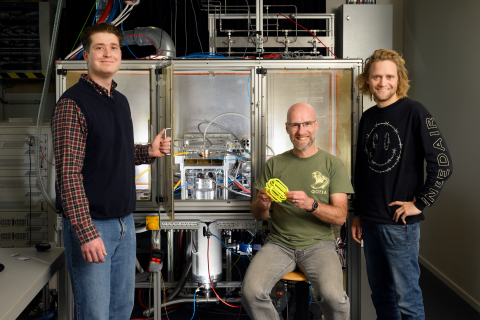
The realisation of an innovative heat exchanger is a recent achievement at DIFFER where science, engineering and craftsmanship come together. A team of experts contributed to this brand new setup, among others PhD researcher Jonas Gans, construction engineer Hans Vullers and precision instrument maker Nick Maes. Each from their own specific area of expertise.
Economical, ecological and social benefits
A heat exchanger itself is nothing new. However, Gans is working on microwave plasma technology for fertiliser and food production. Specifically, together with his team he is upgrading manure that is put on the fields. A big advantage of this technology is the contactless design by which no metal particles enter the gas and therefore do not eventually end up in the manure, on the land, on our plate, and in our bodies.
Using this plasma heated method, a farmer can process the manure in a tank into a more sustainable form than traditional fertilisers are. Gans: “Ammonia is a base, the heated gas is an acid, and when you combine them, you get a type of manure with lower ammonia emissions. This is an attractive method for farmers from both an economic and social perspective, because they can produce the manure themselves and thus become less dependent on the industry. Ecologically, it offers advantages because it helps reduce the nitrogen problem.”
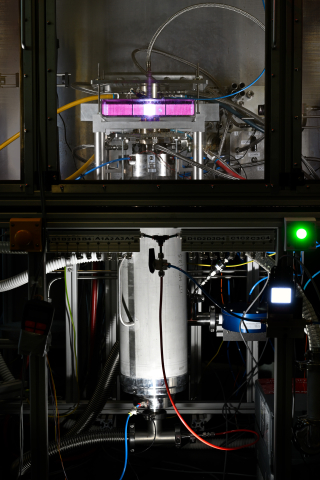
Gans: “With this heat exchanger, we have demonstrated that we can handle higher temperatures and thus use more power and build a larger machine. Our current setup can handle 4 kilowatts. Ultimately, we want to scale up to 10 or even 100 kilowatts. The only problem: the cost of the reactor. We’ve almost reached the point where it’s efficient enough for commercial use.” The innovation of this heat exchanger lies in the fact that it could lead to, for example, a practical application for farms. Ideally, we want the heat from the plasma process to be integrated into the farm operations.
Unique convergence
As with any innovative project, not everything went smoothly, explains Maes. “Sometimes, theory and practice differ. For example, a colleague might draw something that can’t actually be made. Fortunately, we can then make adjustments in consultation to ensure it remains functional and still works.” One of the hurdles the teams had to overcome were the dimensions of certain pipes, adds Vullers. “The setup had a 200 mm diameter opening, and the heat exchanger had to fit through it. We couldn’t find the right raw material (a pipe with the exact diameter). In the end, together with colleagues from the mechanical workshop, we found a solution. We made a tube ourselves with the required sizes, and created flanges so we could weld it. When something like that works out, it gives me a real sense of achievement.”
In the design office, there are general ideas of what DIFFER can realise in the mechanical workshop. There is quite a bit of overlap, but still they are experts in their own field. Vullers: “Once I had made up a design, together with Maes I discussed how to make a product out of a massive piece of stainless steel. Maes knows exactly how to manage this, what the sequence will be. He asked me concrete questions like ‘can this part be a little ticker?’ or ‘is it really important for this edge to be this big?’.” Maes: “I saw my colleague making drawings for the project, not knowing yet that I was going to be the one who could manufacture it. The drawings looked good and I immediately was hoping I’d be the one to manufacture it. Luckily, in the end it became ‘my’ project.”
Strengthening each other
To achieve this kind of innovation, you need to bring all disciplines together. Maes: “One of the reasons why we’ve been able to realise this at DIFFER, is because it involves research. Beforehand, it was unclear whether the heat exchanger would work in this way. If it didn’t, that would also have been a result from which we could learn something. A company would probably only embark on such a project if it could make a profit from it. Not to mention the fact that very few companies have all the necessary disciplines under one roof.”
As for Maes, it is the tangible results, as well as the variation, that appeal to him about working under DIFFER’s roof. “Even though I’m using the same machines, at DIFFER I’m always working on something different”, he explains. “Furthermore, it are the short lines of communication that characterises DIFFER and contributes to colleagues strengthening each other. It’s also about trusting each other to do a good job. I trust my colleague to produce a good drawing. But even if something doesn’t work out well, we’ll find a solution together.”
A well working device
In the end, the newly designed heat exchanger fortunately turned out to work well. For Maes, mainly combining the different processing methods to make it work is what makes him proud. “My task was to make everything in accordance with the drawing and to assemble it, and I succeeded in doing so.”
And what about the residual heat obtained via the heat exchanger? Gans: “Heat generation is not the aim of microwave plasma systems. When it comes to generating heat, a heat pump is far more efficient. But, if you do end up producing fertiliser this way, the hot water you obtain ‘for free’ is a nice bonus. The farmer who uses it could take a hot shower with it."
Jonas Gans is working as a PhD researcher in the Plasma Solar Fuels Devices research group. You can read more about the group’s research on the DIFFER website.
Author: Rianne van Hoek
Go to the News page.