Postdoctoral researcher Maria Morbey has won the very first inaugural DIII-D Doctoral Research Prize for her thesis ‘Deuterium Dynamics in Lithium Layers: Retention and Release Under Fusion Relevant Plasmas’. In 2025 she celebrated her promotion, for which she delved into the research question ‘Can we have lithium in a plasma facing component?’
Morbey conducted part of her doctoral research at DIII-D, a U.S. Department of Energy (DOE) national fusion facility in California, and at Princeton Plasma Physics Laboratory (PPPL). The award recognizes innovation and originality of research, scientific rigor and methodology, impact to the field, and clarity and quality of scientific writing.
Liquid metals
Morbey was the first one at DIII-D to do research on liquid metals after two decades. At DIII-D, she investigated how lithium interacts with fusion plasmas and reactor walls. Using the impurity powder dropper, she studied lithium deposition, erosion and fuel retention during PPPL-led experiments on DIII-D exploring real-time lithium wall conditioning and suppression of edge-localized modes, potentially damaging bursts of plasma energy.
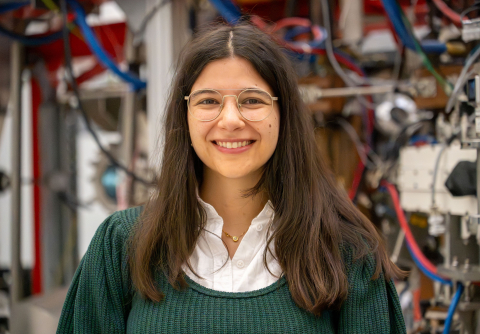
Morbey: “I have been at DIII-D in San Diego for one year in the period 2023-2024. Before doing my own bigger experiment, I did a piggyback experiment by making use of the plasma of another experiment that was already underway. That was an experiment for which I used a small amount of lithium.
A few months later, I overcame a few administrative hurdles to get my own (precious) experimental time, which enabled me to use a bigger amount of lithium and to focus on my own plasma in the right conditions. It was a pleasure to work on the DIII-D tokamak. It has a good set of diagnostics, especially for materials research. Besides, it’s the only mid-size tokamak operating in the US.”
An important finding of Morbey was that deuterium retention in solid lithium coatings is primarily governed by lithium-deuterium co-deposition rather than the initial coating thickness. Her work with lithium-filled capillary porous structures supports DIFFER’s mission to research liquid-metal plasma-facing components for future fusion reactors. The fuel-retention results were published in Nuclear Materials and Energy in 2025.
Global efforts
The news came at a moment when Morbey was focused on something quite different: she was on maternity leave when an unexpected email informed her that she had won the research prize. “In between changing diapers and caring for my newborn daughter, I quickly checked my emails and came across the wonderful news. It made me incredibly happy. It also reminded me how fortunate I am to now be able to combine two things that mean so much to me: being a mother and pursuing my passion for fusion research. I want to show my daughter that you don't have to choose between having a family and pursuing your ambitions. You can embrace both and strive to do well in both.”
Also for Morbey, winning a prize goes hand in hand with thanking people: “I want to thank DIFFER for giving me the opportunity to steer my own research during my PhD and for supporting my wish to spend a year at DIII-D. I am also grateful DIII-D for the opportunity and PPPL for making me part of their group. My group leader Thomas Morgan trusted me and my vision, while the researchers at both institutes welcomed me and supported my work, especially Florian Effenberg who mentored me. And, of course, I have to thank my husband, because without him, I would not have had this opportunity.”
In 2023 Morbey’s husband was asked to work in San Diego for ASML. This presented them with what is often called the ‘two-body problem’: the challenge of balancing two careers while staying together. “I didn’t really feel like choosing”, Morbey recalls. “Fortunately, I knew that DIII-D was located in San Diego. I approached Thomas Morgan, to ask whether I could deviate from my original PhD plan. Initially, my research was focused exclusively on linear plasma devices, but I saw no reason why I couldn’t include experiments on a tokamak as well.”
“Morgan put me in contact with Tyler Abrams (General Atomics scientist), who had completed his PhD at PPPL while conducting part of his thesis research at DIFFER. Tyler then introduced me to Florian Effenberg (PPPL scientist). Florian was preparing experiments to investigate the effects of dropping lithium powder into the plasma. He was very supportive of my involvement and allowed me to use these plasma shots to collect lithium in DiMES and carry out my own plasma-material interaction studies.”
“As you can see, people in fusion research are very interconnected and always eager to help one another. It's a really wonderful community.”
Valuable
What started as a way to avoid living apart from her husband turned into a valuable opportunity to expand her research and build an international network. Students and researchers from all over the world come to DIII-D to conduct experiments, and DIFFER researchers have also benefited from these international connections.
“At DIII-D, I met many researchers from all over the world, each working on different challenges in fusion research. Being part of this international community has been a great experience. And ultimately, these connections and collaborations also contributed to my research achievements and the honor of receiving this prize, which makes me even prouder of my work.”
Read more about Maria Morbey and her research work in the article ‘From plasma to power: managing hydrogen isotopes in the walls of future fusion power plants’, written for DIFFER’s website in August 2025. PPPL also published a news article about Morbey winning the inaugural DIII-D Doctoral Research Prize.
Authors: Maria Morbey and Rianne van Hoek
Go to the News page.