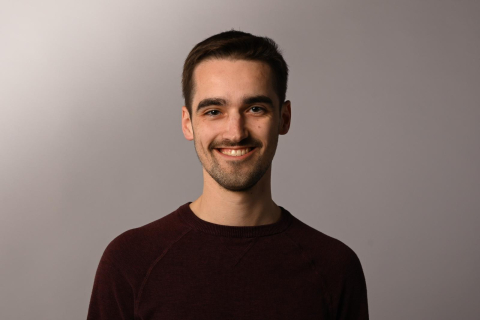
Photoelectrochemical water splitting offers a way to produce green hydrogen directly from sunlight and water. It could become a key technology in the production of sustainable fuels and in the chemical industry. Identifying suitable semiconductor materials is a major challenge, just like understanding the oxygen evolution reaction that takes place. Therefore, PhD student Bart van den Boorn developed a computational model that couples semiconductor physics and electrochemical reactions. On 12 May 2026 he successfully defended his thesis.
Although photoelectrochemical (PEC) water splitting offers a way to produce green hydrogen directly from sunlight and water, PEC cells are not efficient enough for large-scale use. A major challenge is identifying suitable semiconductor materials that efficiently absorb sunlight and have suitable properties for water splitting. To understand this process, we need to study the oxygen evolution reaction (OER), the reaction mechanism that creates oxygen. This is important, because the OER largely determines the efficiency of a cell. Specifically looking at this reaction, was the focus of Van den Boorn’s research.
Physical modeling and experiments
In his research, Van den Boorn focused on two aspects. Firstly, on the development of a computational model that couples semiconductor physics and electrochemical reactions. Secondly, on the development of tools, such as parameter estimation and sensitivity analysis, that use the model to give insight into the key parameters of the semiconductor material and the OER mechanism.
Van den Boorn: “The modeling framework developed in my dissertation connects detailed physical modeling with experiments. This leads to improved understanding of the OER mechanism and provides practical tools for fast and reliable evaluation of prospective semiconductor materials, thereby contributing to the advancement of photoelectrochemical water splitting and efficient solar hydrogen production.”
DIFFER community
Van den Boorn: “I look back on a pleasant time at DIFFER. When I started my PhD programme in 2021, there were lots of people in the group. After a while, things quietened down a bit (in the office too), but fortunately, new colleagues joined us over time who made the office more lively again. At DIFFER, there are also PhD students from all the different research groups that you can catch up with. I’ve developed close friendships here. Another thing I really enjoyed during my PhD were the trips abroad. For instance, I attended various conferences in Sweden, the US and Germany.”
On a professional level, Van den Boorn has made quite some progress during his PhD trajectory: “I can say I have learned a lot in the past years. For instance, defining and framing my research project and deciding what to focus on. A necessary task, as my research project had a quite broad scope in the beginning. I have also gained experience in sharing my knowledge with other people, and the best ways to communicate.”
Looking ahead to the future, Van den Boorn is currently exploring his options on the job market: “With my background in mechanical engineering and nuclear fusion, I see there are various options for me. It could be something in high-tech, or something related to the energy transition. I’d like to keep my options open, as there are plenty of possibilities for me in this high-tech Brainport region.” And his research? “New PhD students at DIFFER will continue the journey. They will -among other things- explore how to make my model more efficient and investigate the OER mechanism using the tools that I developed”, explains Van den Boorn.
Read more about Van den Boorn’s research work and download the full thesis on the TU/e website.
Authors: Bart van den Boorn and Rianne van Hoek
Go to the News page.