As of July 1, Niels Deen has been appointed scientific director of the Eindhoven Institute for Renewable Energy Systems (EIRES). In this next phase, he will work closely with Managing Director Diana van der Sloot to further strengthen EIRES as a leading interdisciplinary institute for renewable energy systems. Deen succeeds Richard van de Sanden, who will return to science full time as a group leader at DIFFER.
Niels Deen is no stranger to EIRES: he has been closely involved in the institute since its inception. The full professor, current vice-dean of the Department of Mechanical Engineering and leader of the Power & Flow group was a member of the EIRES management team from 2020 to 2024, co-led the former EIRES focus area Engineering for Sustainable Energy Systems, and coordinated TU/e’s contributions to the energy-related Growth Fund programs GroenvermogenNL and Growing with Green Steel.
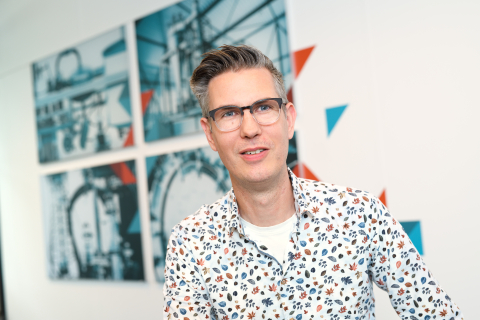
Personal motivation
‘Energy research is both scientifically very challenging and socially highly relevant. The energy transition is an important and far-reaching topic that spans an extremely complex challenge and a wide variety of applications. So, for me, it was a no-brainer that I wanted to join this new institute,’ Deen states when asked about his motivation to join EIRES from the start.
‘A lot of great research is being conducted in this field, both at the university as a whole and within EIRES,’ he says. ‘This ranges from projects about electrical power grids to understanding materials at the atomic level. As a member of the EIRES management team, I’ve always found it very rewarding to reflect on how we could connect those scales, disciplines, and perspectives. I’m very happy and grateful that I now get to do that for two days a week as the institute’s new scientific director.’
Building an image
Over the years, Deen has seen the institute grow and mature. ‘We launched the institute during the pandemic, at a time when we couldn’t meet in person. Despite these hard conditions, we’ve managed to build a large and strong community that has become a visible force, not only within our own university, but on a national scale as well. That is largely thanks to the relentless work of the founding directors Mark Boneschanscher and Richard van de Sanden. I would very much like to further strengthen that image and expand it across Europe.’
Another ambition Deen has for EIRES is to ensure that, in collaboration with the ecosystem, a roadmap is drawn up for each of the institute’s five focus areas, outlining how to advance these topics. ‘And in terms of content, I would like to look more closely at electrification at various Technology Readiness Levels. Electric cars, for example, are already quite established at a high TRL level, meaning that the scientific questions are mostly at the system level - for instance, how bidirectional charging can enable cars to function as batteries within an energy grid. But electric ships are still in the very early stages of their development; there are many fundamental challenges we need to overcome before long haul electric shipping will be a reality.’
Bottom-up organization
Even though he has plenty of ideas about the future of the institute, Deen stresses that EIRES is and will remain a bottom-up organization that does not tell researchers what to do: ‘EIRES is for researchers, by researchers. Our most important task as an institute is to bridge disciplines and connect scientists so they can develop larger-scale programs and actually help accelerate the energy transition.’
Deen wants to further strengthen the links between EIRES and the departments, and involve even more people with the institute. ‘To this end, I want to follow an example set by our dean Patrick Anderson, who introduced regular board visits to hear directly from research groups what challenges they are facing. As a scientific director of EIRES, I’ll of course talk to board members and directors, but I definitely also want to connect directly with the researchers themselves. And not online, but face to face. Because then you see what binds you, instead of what sets you apart.’
This approach is one of the examples of how Deen wants to implement his personal motto for the institute: “EIRES, where people innovate energy systems for society”. Deen: ‘Over the past ten years, I’ve realized that my strength lies in bringing people together. And that also happens to be what I find the most rewarding thing to do. This new role I am now taking on uniquely allows me to combine everything I stand for: connecting people to take on a technically complex challenge that has a significant societal relevance.’
Passing the baton
It was after the successful Mid Term Review of EIRES that its founding scientific director Richard van de Sanden felt the time had come for him to step down and pass the baton to the next generation. ‘With EIRES, we’ve achieved something truly wonderful,’ he says with pride. ‘We’ve not only built a strong community of researchers, but also an ecosystem of associated industrial and societal partners. Where in the early days, we were mostly convincing people of our vision, they are now coming to us because they want to be part of our community.’
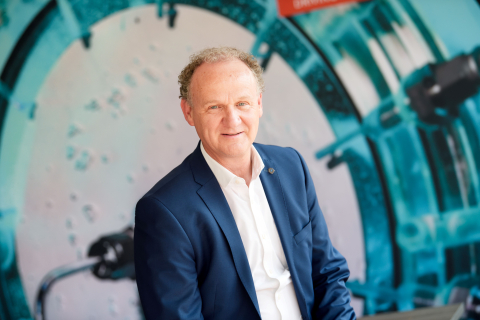
Over the past 6 years, EIRES managed to significantly multiply the initial investments made by the university’s Executive Board, he adds. ‘By bringing together scientists from different disciplines and taking a stimulating and facilitating role, we’ve helped TU/e’s energy community to acquire multiple large-scale, transdisciplinary research and innovation grants. And with our GENIUS- and BACH-projects, we are turning the campus itself into an energy hub, demonstrating innovative solutions in practice.’
Key to success
According to Van de Sanden, the key to this success lies in the choices that were made right from the start. ‘The Executive Board gave us a great deal of freedom to shape the institute according to our own vision. From the very beginning, Mark Boneschanscher and I deliberately chose for EIRES to be a bottom-up institute focused on the boundaries between disciplines, with a particular emphasis on modular, scalable systems and the manufacturing industry. That has worked out very well. We are now nationally recognized for our expertise, our open and collaborative attitude, and our clear connection to the regional manufacturing industry.’
Building leadership
Another success factor is the way the institute is organized, he states. ‘From day one, we established a strong management team that brought together a very diverse set of people. We also made a point of involving young people rather than the usual suspects. This gave them the opportunity to become part of TU/e on a different level, to gain insight into policy considerations, and to develop a broader perspective on the university as a whole. In doing so, we built new and broad leadership in the field of energy. This also enabled us to present the outside world with a wide variety of experts on the energy transition, in the broadest sense.’
Looking back, Van de Sanden is proud to see how the idea of taking a step back and facilitating the field to organize itself has worked out. That also relates to the only advice he has for his successor: ‘Do not try to do everything yourself. Give others room to grow and provide them with a platform to share their ideas. That will only benefit the institute’s reputation and, with it, the opportunities for new research.’
It is that research that Van de Sanden himself is now fully returning to. ‘For the final part of my career, I want to dedicate most of my time to working with young people on the use of plasmas for gas conversion. I began working on this topic in 2010 when I joined DIFFER, and we are now on the verge of demonstrating the practical applications this technology has always promised.’
Text: EIRES
Go to the News page.