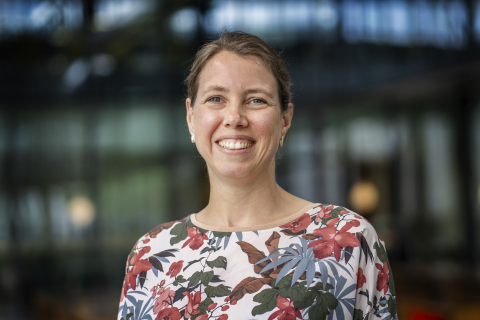
On February 11 it’s the ‘International day of women and girls in science’. A perfect occasion to put Loes Jansen in the spotlights. Since the summer of 2024 Loes works as a PhD candidate in the Energy Systems and Control group at DIFFER’s Fusion Energy department. What do escape rooms have to do with her career? How does she combine motherhood with working in science?
You have been a PhD candidate at DIFFER since the summer of 2024. What is your PhD research about?
I work on control engineering for nuclear fusion. I focus on how we can supply fuel to a fusion reactor by injecting ice pellets into it. Because the edge of the plasma in a fusion reactor becomes extremely hot, adding fuel to the plasma is quite a challenge. The fuel consists of hydrogen isotopes, which ionise and are immediately discharged to the exhaust. One solution is to shoot ice pellets, which do enter the plasma, but that in turn poses challenges in terms of control technology.
You can best compare this to a leaking bucket of water that you have to keep at the right level by popping water balloons above the bucket. It's impossible to control this very precisely, and I'm trying to figure out how we can deal with that.
Who do you work with at DIFFER?
I am part of the Energy Systems & Control group led by Matthijs van Berkel. We are a large, enjoyable group in which everyone works on (roughly) the same thing, each with their own approach. This makes it consistently interesting to discuss ideas. People are very willing to help. I think that's generally the case at DIFFER. For example, when I have a new idea, my colleagues all come to take a look and give feedback.
In my group, three colleagues work specifically on pellet control, each from their own perspective. It is the combination of these perspectives that makes it interesting. There is also frequent interaction with Sven Wiesen's Integrated Modelling research group.
What does your career path look like?
I graduated as a Mechanical Engineer at KU Leuven in 2007. Since then, I have worked in various sectors, such as automation in the process industry, machine construction for handling bulk goods, and project management in the construction of solar parks. In addition, I have also started my own businesses, as an installer of heat pumps and solar panels and in escape rooms.
Escape rooms, that sounds creative. Can you tell a bit more about this?
I am quite entrepreneurial, and when escape rooms started popping up in Belgium and the Netherlands, I thought we could innovate in that market. I saw opportunities for myself given my background in automation. Specifically, the idea came about when I played an escape room with my husband, who works in IT. We thought 'we can do better than that'. In 2017, we opened the first escape room in the Benelux without any padlocks. Since then, we have grown to two locations and I have a good team for the operational tasks.
Why did you choose a career in science?
I felt that something was missing in my work and that I wanted to do something innovative and high-tech. I also wished to contribute to society in some way. At university, after completing my engineering degree, I had also taken a few physics courses, but that felt more like a hobby. I wanted to continue with that, so I attended an information session at the university where I met a professor who convinced me to consider a PhD. The thought 'I'll never be eligible for that' did cross my mind for a moment. When this professor told me that I did indeed have a chance, I decided to go for it. I started looking for vacancies that matched my interests (engineering, physics, renewable energy) and luckily I found them!
How do you feel about working as a woman in science, among mainly male colleagues?
Since I have always had a technical job, I have spent my entire career in a 'men's world'. I have had to learn to deal with that, because it has both advantages and disadvantages. Fortunately, I have noticed that there is more acceptance and openness in this environment. Not only towards women, but towards minorities in general.
What would you like to say to girls considering a career in STEM?
Just do it! But that applies to any career choice. The world was created by people who are not better or smarter than you are. I often see much more doubt and less self-confidence in women; they quicker feel that they are not doing things well enough. I notice this even among women who have already achieved a great deal in science. Those ideas are often unfounded, so don't let yourself hold you back.
In addition to a challenging job in science, you also have a busy family life. How do you combine this?
I have four children; twins aged six and twins aged eight. I am able to combine work and family life thanks to my wonderful husband, who is also fully committed to the family and supports me in my decision to pursue a PhD. We also have an au pair, and we can regularly count on the help of the grandparents.
From my experience, I would advise other women to dare to ask for help and to enjoy family life to the fullest. I have never regretted taking a break from focusing on my career. Life is a journey, not a destination.
Authors: Loes Jansen, Rianne van Hoek
Go to the News page.