Group leader: Dr. Michail (Mihalis) N. Tsampas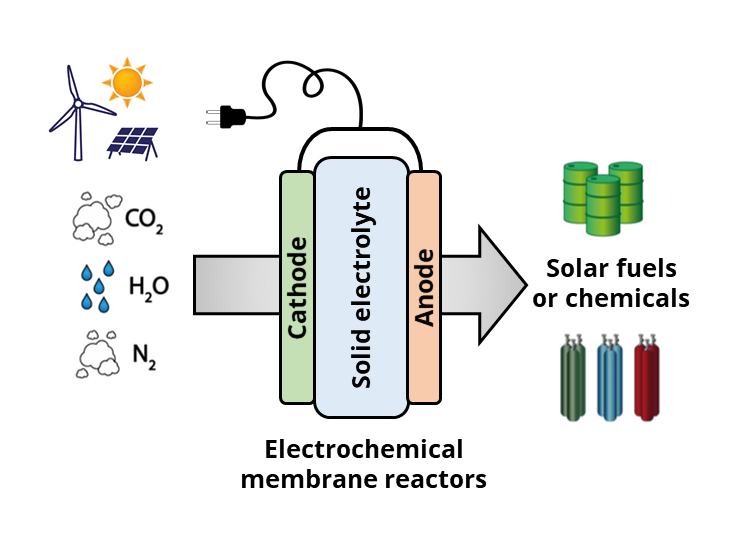
Research Vision and Strategic Focus
The research of CEPEA focuses on developing electrochemical membrane reactors and hybrid electrochemical technologies for renewable fuel production and the electrification of the chemical industry. Our vision is to enable a paradigm shift in the way renewable electricity is converted, stored, and utilized by transforming intermittent renewable power into stable, high-energy-density chemical bonds.
Our research operates at the interface of materials science, electrochemistry, catalysis, and reactor engineering, combining fundamental understanding of electrochemical interfaces with the development of technology-relevant devices. At the core of our activities are Anion Exchange Membrane (AEM), Proton Exchange Membrane (PEM), Protonic Ceramic Electrochemical Cell (PCEC), and Solid Oxide Electrolysis Cell (SOEC) platforms. Our work spans the complete development chain, from materials and functional components to membrane-electrode assemblies, reactor architectures, and laboratory-scale systems, with scalability and industrial implementation considered from the outset. We develop and integrate advanced polymeric and ceramic ion-conducting materials to enable the efficient conversion of renewable electricity and sustainable feedstocks such as water, carbon dioxide, nitrogen and biomass-derived molecules into fuels and value-added chemical intermediates. Representative applications include water electrolysis, carbon dioxide conversion, nitrogen fixation, and the electrochemical valorization of biomass-derived streams.
A central element of our research is the engineering of electrocatalysts and functional interfaces across multiple length scales. We employ advanced materials strategies including nanoparticle synthesis, spark ablation, plasma-induced nanostructuring, and catalyst exsolution to increase electrochemically active surface area, control catalyst–support interactions, and ultimately achieve improved control over the nature and accessibility of catalytic sites.
Beyond conventional electrochemical conversion, CEPEA develops hybrid activation concepts combining electrochemistry with light and plasma. These approaches are designed to overcome intrinsic limitations associated with conventional catalysts, reaction pathways, and operating conditions, opening alternative routes toward more selective and energy-efficient chemical transformations.
A strong emphasis is placed on operando and in-situ characterization, linking changes in catalyst structure, interfaces, ion-conducting phases, and device components directly with electrochemical performance and degradation. This understanding is used to guide the rational development of more efficient, selective, and durable electrochemical reactors.
Ultimately, CEPEA aims to bridge fundamental electrochemical science with scalable energy and chemical technologies. By integrating advanced materials engineering, innovative reactor architectures, hybrid activation strategies, and mechanistic diagnostics, we seek to deliver robust solutions for renewable fuel production and industrial electrification that contribute to European decarbonization, energy security, and the transition toward a sustainable chemical industry.