Background
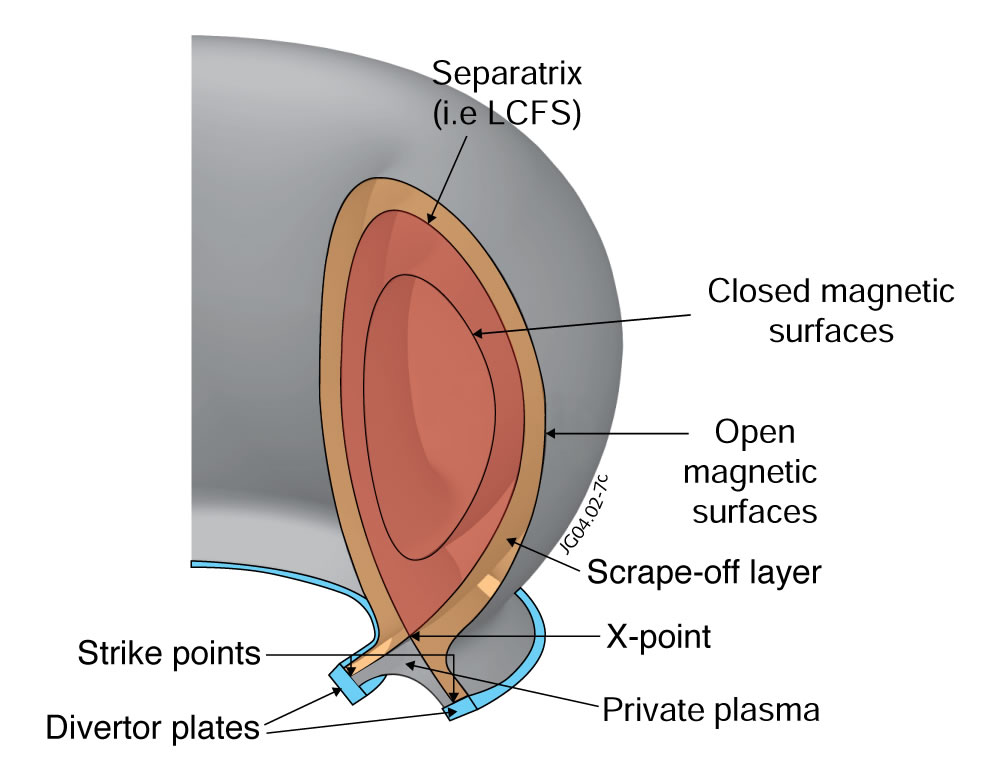
its interaction with the divertor.
One of the main challenges to the realization of a fusion power plant is the problem of power exhaust. The dominant magnetic confinement approach to fusion uses a tokamak, a toroidally shaped magnetic bottle able to confine a plasma at sufficient temperatures and densities for efficient energy production. Tokamaks employ a divertor, a region located far from the plasma edge, to exhaust the waste heat and the helium particles generated from the fusion reaction. Heat escaping from the confined region flows along a thin layer (the scrape-off layer or SOL) to a narrow surface ring a few cm wide at the divertor plates. This heat may be hundreds of Megawatts with ion temperatures of hundreds of electronvolts (millions of Kelvin) as it leaves the confined region, while being exhausted onto an area of only a few square meters. Such ion energies would quickly erode any solid divertor surface via sputtering while such sustained heat densities would lead to melting within a few seconds.
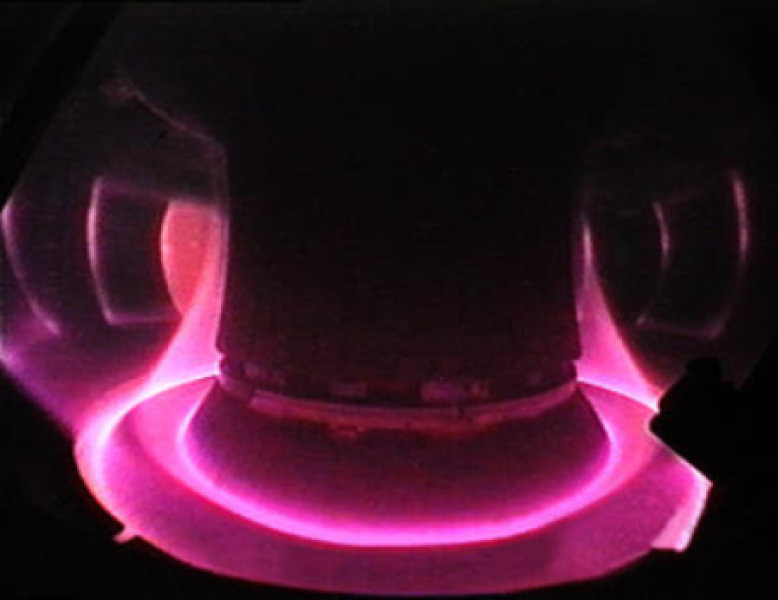
tokamak
To reduce heat loads and ion energies to protect the wall, radiation and interactions with neutral particles combine to induce a state called detachment where the plasma is cooled to a few electronvolts and significant energy, momentum and particle flux reductions occur. This is achieved by injecting impurities and carefully adjusting the upstream plasma conditions, but control of this is highly challenging, with the consequences for loss of control severe. Intense neutron loads will also penetrate the materials from the fusion process, creating transmutations and collision damage which strongly evolves the material properties. The fuel ions can become implanted or co-deposited at the walls, which has consequences for the fuel cycle and safety, meaning this effect must be monitored. And as well as the steady-state loading off-normal states such as Edge Localized Modes (ELMs), slow transient detachment loss and disruptions will strongly affect and damage the plasma facing materials.
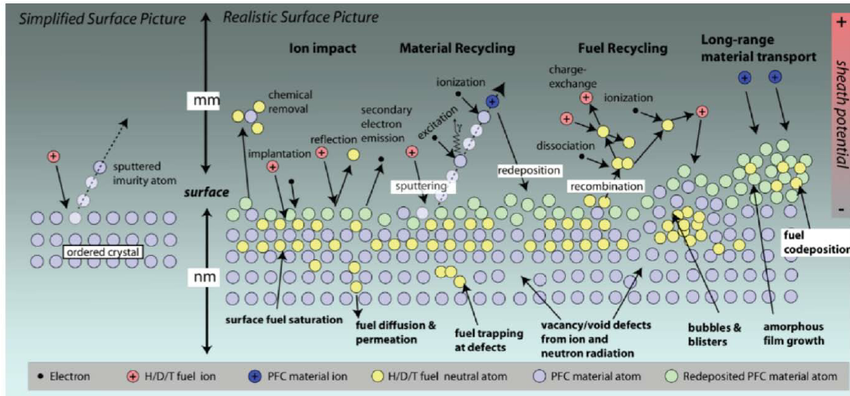
As a result the divertor materials experience a complex and changing environment, where implantation, erosion, re-deposition and radiation damage lead to atomic and microstructural evolution. Predictions for material performance in future fusion reactors is hampered by the fact that current-day tokamaks do not achieve as extreme conditions. DIFFER’s linear plasma devices Magnum-PSI and UPP enable detailed, well diagnosed studies under reactor divertor-relevant conditions.

DIFFER is a member of the EUROfusion consortium, which comprises 30 fusion research organisations and universities from 26 European member states plus Switzerland and Ukraine.